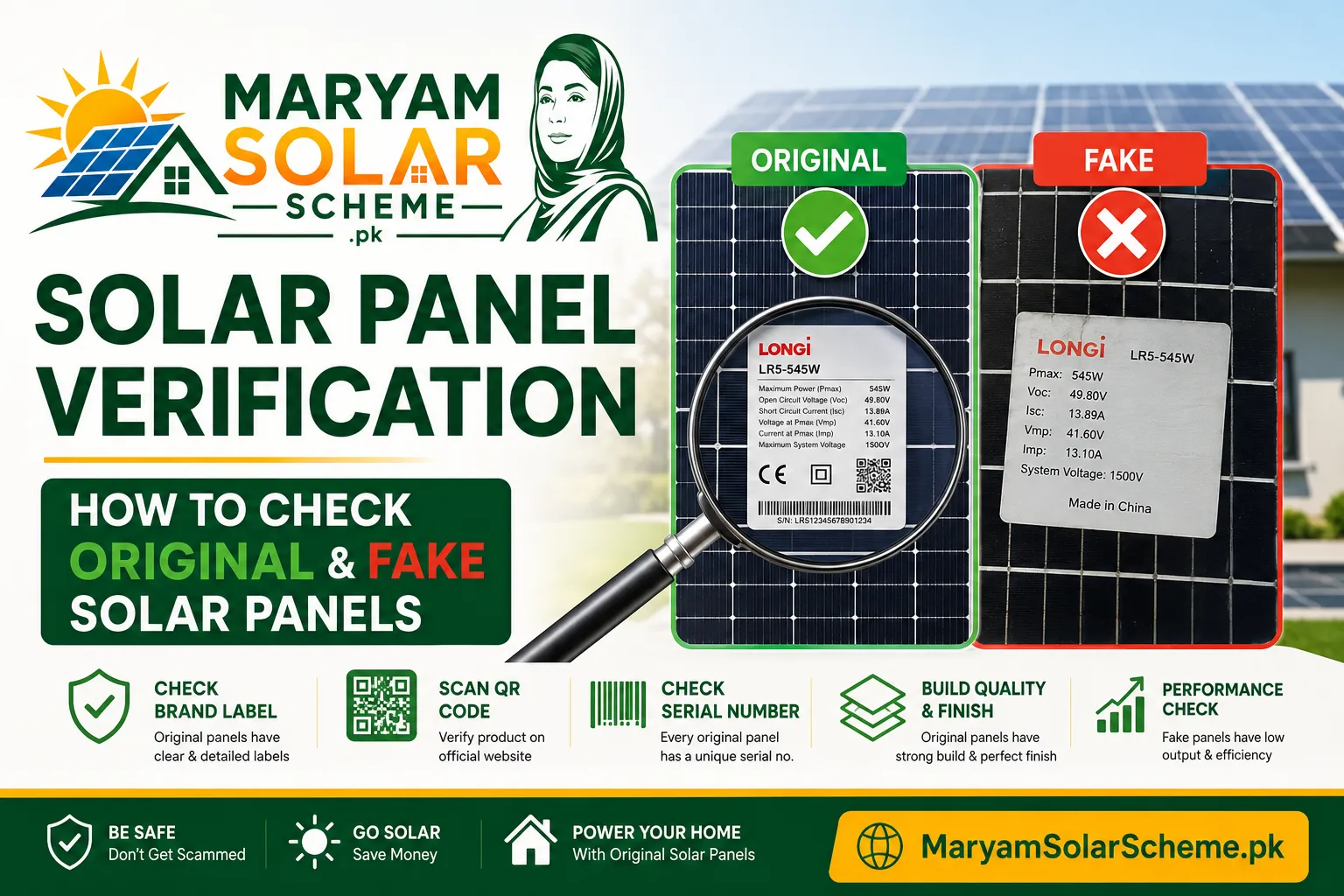
Solar Panel Verification made simple. Learn how to check original panels, avoid fake solar products, and verify using official links.
Fake solar panels have become a serious problem in Pakistan’s solar market. Many of these panels look completely original from the outside — they carry well-known brand names and are often sold at attractively lower prices. The trouble usually starts after installation, when buyers face low power output, early panel failure, and no real warranty support to fall back on.
This is exactly why Solar Panel Verification has become an essential step before buying any solar panel. It lets you confirm whether a panel is genuinely manufactured by the brand it claims to be, rather than a fake or rebranded copy. Since a solar system is meant to last 20 to 25 years, a two-minute verification step can protect a very long-term investment.
Table of Contents
Why Solar Panel Verification Is More Important Than Ever
Solar demand in Pakistan is growing quickly, and that growth has opened the door to a flood of low-quality and fake panels entering the market. Most new buyers simply don’t know how to check a panel properly, so they end up relying on appearance and the seller’s word alone.
Without proper verification, you’re trusting looks and claims over facts. Fake panels can reduce system efficiency by 20 to 40 percent, which quietly eats into your monthly electricity savings for years. On top of that, fake panels rarely come with a real manufacturer warranty — if one fails, replacing it becomes entirely your own cost and problem. Verification isn’t an optional extra step anymore; it’s a necessary part of buying solar.
What Exactly Is Solar Panel Verification?
Solar Panel Verification is the process of confirming whether a solar panel is genuinely registered in the manufacturer’s official database, using real records instead of guesswork or visual inspection alone.
Every original solar panel carries three key identifiers:
| Identifier | Purpose |
|---|---|
| Unique serial number | Links the panel to the manufacturer’s production record |
| Barcode or QR code | Allows quick digital lookup of the panel’s details |
| Manufacturer database record | Stores the official specifications tied to that serial number |
When you enter this data on the brand’s official verification website, the system returns the real product details if the panel is genuine. If the panel is fake, the system either shows an error or returns no result at all.
In simple terms: verification means checking a panel’s identity against the company’s own records, not just trusting what’s printed on a sticker.
Solar Panel Verification vs Authenticity
Many buyers assume authenticity and verification mean the same thing, but they’re actually two different concepts.
| Term | What It Means |
|---|---|
| Authenticity | What the panel claims to be, based on labels and appearance |
| Verification | Proof that the claim is actually correct, based on official records |
A panel can look completely authentic — right sticker, right color scheme, right logo — and still be fake. For example, a panel carrying a LONGi sticker may look entirely real, but only official verification can confirm whether it is actually a genuine LONGi product.
Types of Solar Panel Verification Methods
There are several ways to verify a panel, and the safest approach is to combine more than one method rather than relying on just one.
| Method | How It Works | Reliability |
|---|---|---|
| Serial number verification | Enter the panel’s serial number on the official brand website | Most reliable method |
| QR code scanning | Scan the QR code printed on the panel using a mobile phone | Reliable, but always cross-check with the website |
| Barcode verification | Some brands support scanning a barcode for lookup | Moderately reliable, brand-dependent |
| Manual product matching | Compare wattage, model number, and label details manually | Useful as a supporting check, not standalone proof |
The best approach combines all three core methods — serial number, QR code, and a physical visual check — rather than depending on any single one.
Brand-Wise Solar Panel Verification Table
Verification methods vary slightly from brand to brand. Here’s a quick reference for some of the most common panel brands sold in Pakistan.
| Brand | Verification Method | What You Check |
|---|---|---|
| LONGi Solar | Serial + QR | Model, wattage, batch |
| JA Solar | Serial | Module details |
| Jinko Solar | QR + Serial | Product record |
| Trina Solar | Serial | Manufacturing info |
| Canadian Solar | Serial | Panel specifications |
| Astronergy | Serial | Genuine module |
| Risen Energy | Product code | Authenticity |
| Crown Solar | Label check | Basic identity |
| AIKO Solar | Serial | Model confirmation |
Always run verification through the official brand website only — third-party tools or unofficial apps cannot be trusted for this step.
Step-by-Step Solar Panel Verification Guide
Step 1: Locate the Serial Number
Check the back or frame of the panel for the printed serial number. Make sure the print is clear, free of scratches, and shows no signs of tampering. A missing or unreadable serial number is a major red flag on its own.
Step 2: Inspect Label Quality
| Original Labels | Fake Labels |
|---|---|
| Clean, sharp printing | Faded or blurry printing |
| Properly aligned text | Crooked or uneven alignment |
| No spelling mistakes | Occasional typos or odd wording |
| Permanent, factory-applied | Looks newly pasted or added later |
Step 3: Use the Official Verification Tool
Go to the brand’s official website and enter the serial number, or scan the QR code directly. A genuine panel returns full product details; a fake one returns an error or no record at all.
Step 4: Cross-Check the Details
Match the wattage, model number, brand name, and production information shown by the verification tool against what’s printed on the panel itself. Any mismatch should be treated as a warning sign.
Step 5: Verify Seller Claims
Ask the seller for the invoice, warranty documentation, and import documents. A genuine, honest seller will be able to provide all of this without hesitation or delay.
What a Verified Solar Panel Shows
When verification succeeds, the official system typically displays:
| Detail Shown | What It Confirms |
|---|---|
| Brand name | Confirms the panel matches its claimed manufacturer |
| Exact model | Confirms the specific product line |
| Wattage rating | Confirms the panel’s actual power output |
| Manufacturing details | Confirms production origin and date |
| Batch information | Confirms the specific production batch |
Together, these details confirm that the panel is genuinely original rather than a copy or rebrand.
Physical Signs of Fake Solar Panels
Beyond digital verification, a close physical inspection can reveal a lot about a panel’s authenticity.
| Feature | Original Panel | Fake Panel |
|---|---|---|
| Cell alignment | Straight, evenly spaced lines | Uneven or crooked cell placement |
| Glass quality | Clear, tempered glass | Dull, scratched, or low-grade glass |
| Frame build | Strong, solid aluminum frame | Weak, rough, or poorly finished edges |
| Junction box | Properly sealed | Loose, cheap, or poorly fitted |
| Label quality | Permanent, factory-grade print | Peeling or low-quality stickers |
Hidden Types of Fake Panels
Not every fake panel is an obvious, cheap-looking imitation. Some are far harder to detect without verification.
| Type | Description |
|---|---|
| Refurbished panels | Old, used panels resold as brand new |
| Downgraded panels | Lower-efficiency panels sold as higher-watt units |
| Rejected factory panels | Panels that failed quality control, sold anyway |
| Rebranded panels | Cheap, generic panels sold under a branded sticker |
These hidden categories are surprisingly common in the market, which is another reason official verification matters more than a quick visual check.
What to Do If Verification Fails
| Step | Action |
|---|---|
| 1. Recheck entry | Look for typing mistakes in the serial number |
| 2. Try again | Use manual entry instead of QR scanning |
| 3. Check the website | Confirm you’re on the official, correct verification link |
| 4. Ask the seller | Request supporting documents and explanations |
| 5. Contact the manufacturer | Send clear photos and the serial number directly to the brand |
| 6. Walk away | If doubt remains after all steps, don’t proceed with the purchase |
A solar system is a long-term investment — it’s never worth the risk of proceeding on unresolved doubt.
Biggest Mistakes Buyers Make
| Mistake | Consequence |
|---|---|
| Only looking at price | Cheap panels often carry hidden long-term costs |
| Skipping verification | The single most common and costly mistake |
| Trusting the seller only | Not every seller is honest or fully informed |
| Ignoring warranty | Fake panels typically come with no real support |
| No knowledge of specs | Leads to buying the wrong panel for your needs |
Smart Buyer Checklist Before Purchase
Before finalizing any solar panel purchase, confirm the following:
| Checklist Item | Confirmed? |
|---|---|
| Serial number is present and legible | |
| Panel verified on the official brand website | |
| Verified details match the physical panel | |
| No visible physical damage | |
| Warranty is confirmed in writing | |
| Seller is trusted and provides documentation | |
| Price is realistic for the brand and specs |
Following this checklist consistently is one of the simplest ways to make a safe, informed purchase.
Frequently Asked Questions
How to check if a solar panel is original?
Use Solar Panel Verification through the official brand website by entering the serial number or scanning the QR code printed on the panel. A genuine panel will return full product details, while a mismatch or no result at all is a sign the panel may be fake or unregistered.
How can I check a solar panel?
Check it using its serial number, barcode, or QR code on the manufacturer’s official verification page. Combine this with a physical inspection — proper labeling, clean glass, and solid build quality — for the most reliable result.
How to verify a Jinko solar panel serial number?
Visit Jinko’s official verification page and enter the serial number, or scan the QR code on the panel. Make sure the returned details match your panel’s model and wattage; no result or mismatched information is a warning sign.
How do I check if I can have solar panels installed?
Start by assessing your roof space and sunlight exposure — a roof with direct sunlight for most of the day is ideal. Then check your electricity usage and budget; a solar load calculator can help determine the right system size for your home.
How to check if a solar panel is original or fake?
Use the brand’s official verification tool by entering the serial number or scanning the QR code. Pair this with physical checks like label quality, glass condition, and cell alignment, since fake panels often have noticeably poor finishing.
Do solar panels have serial numbers?
Yes, every original solar panel has a unique serial number, usually printed on a label at the back or side of the panel. This number is essential for both verification and warranty tracking — a panel without a clear serial number is a strong warning sign.
How to check solar panel details?
Enter the serial number on the manufacturer’s official website to view the model, wattage, and production information, then compare these details against what’s printed on the panel itself.
How to check a Jinko solar panel serial number online in Pakistan?
Use Jinko’s official verification tool, entering the serial number or scanning the QR code with your mobile. Always use the official website directly and avoid third-party verification tools.
How to identify a solar panel?
Check the brand label, model number, and physical design, along with the serial number and QR code. Visual inspection alone isn’t enough — always confirm authenticity through official verification tools.
How to check the quality of solar panels?
Look at build materials, glass clarity, and cell alignment, and consider brand reputation and warranty coverage. Verified panels from trusted brands generally offer better long-term performance.
What is the 20% rule for solar panels?
The 20% rule means adding extra system capacity to cover real-world losses, since solar systems rarely operate at full efficiency all the time. For example, if your calculated need is 5kW, installing around a 6kW system helps maintain stable performance even during low sunlight or system inefficiencies.
Conclusion
Solar Panel Verification is no longer an optional precaution — it’s a core part of buying solar equipment safely in Pakistan’s fast-growing but increasingly unregulated market. Combining serial number checks, QR code scanning, physical inspection, and seller documentation gives buyers the strongest possible protection against fake, refurbished, or rebranded panels. Given that a solar investment is meant to serve a household for decades, taking a few extra minutes to verify before buying is one of the simplest ways to protect that investment for the long run.